One-page guides
Short PDFs to print or share: handouts to give a client, and references to keep on your desk. Each one links to the fuller version on Formulate.
Most of these need a free Formulate account to download. There is no card to enter, and the free plan doesn’t expire. Where a guide needs no account, its card says so.
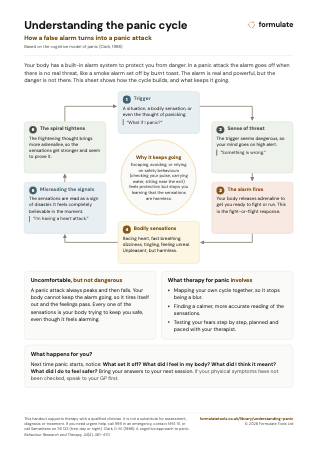
Client handout · 1 page
Understanding the panic cycle
How a false alarm turns into a panic attack, and what keeps the cycle going.
Based on: The cognitive model of panic (Clark, 1986)
Create free account to downloadOpen the interactive worksheet →The download needs a free account. No card required.
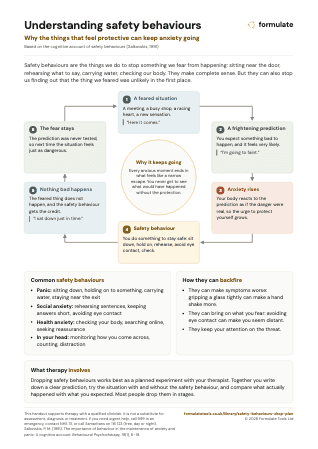
Client handout · 1 page
Understanding safety behaviours
Why the things that feel protective can keep anxiety going.
Based on: The cognitive account of safety behaviours (Salkovskis, 1991)
Create free account to downloadOpen the interactive worksheet →The download needs a free account. No card required.
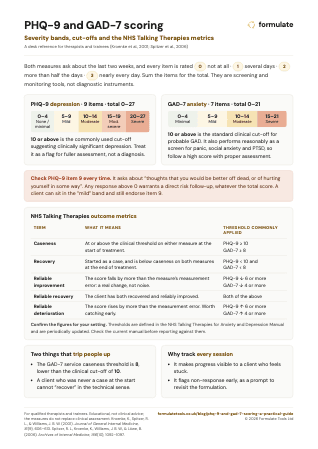
Therapist desk reference · 1 page
PHQ-9 and GAD-7 scoring
Severity bands, cut-offs and the NHS Talking Therapies outcome metrics on one sheet.
Based on: Kroenke et al. (2001) and Spitzer et al. (2006)
Create free account to downloadRead the full scoring guide →The download needs a free account. No card required.
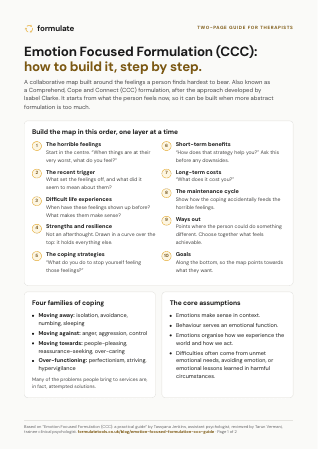
Therapist guide · 2 pages
Emotion Focused Formulation (CCC): how to build it
A step-by-step guide to building the formulation with a client, one layer at a time.
Based on: Comprehend, Cope and Connect, the approach developed by Isabel Clarke
Download PDFOpen the interactive formulation →Free to download. No account needed.
Client handouts are written to support therapy with a qualified clinician. They are not a substitute for assessment, diagnosis or treatment.